
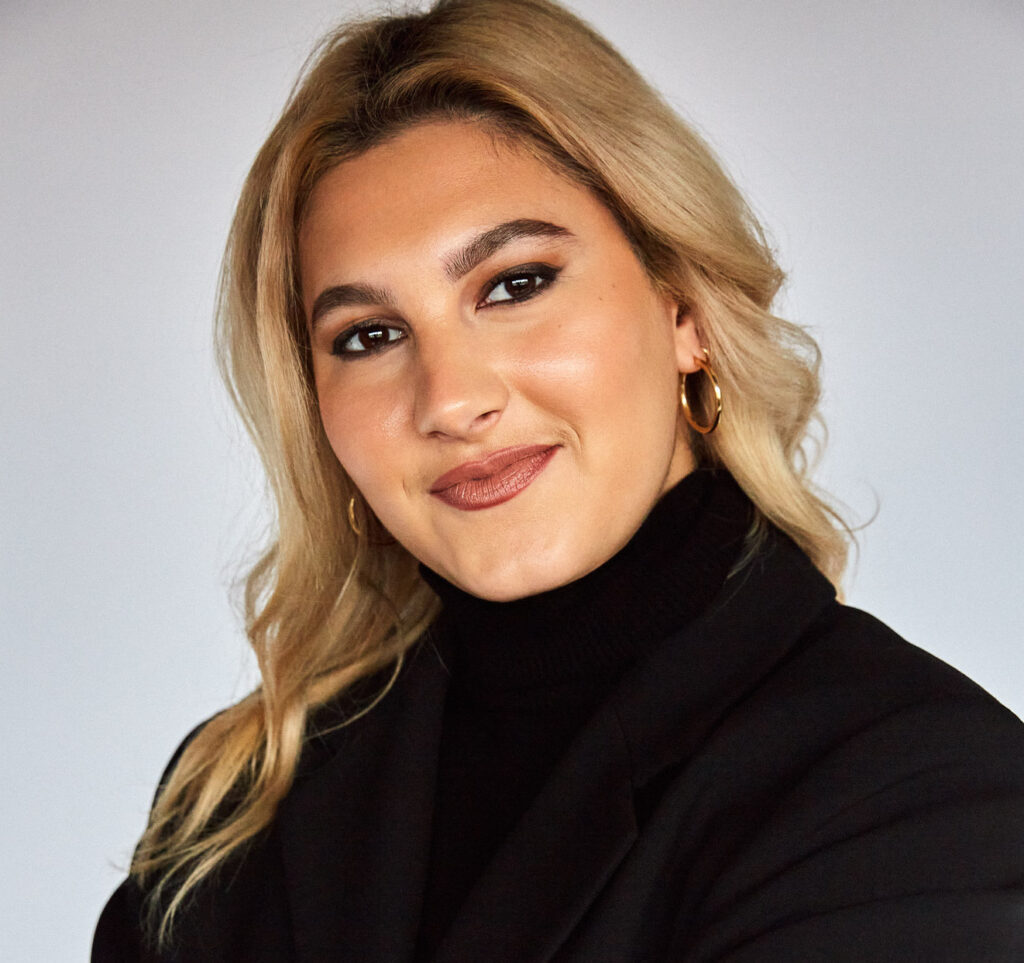
Anastasia Skrypnyk, a Toronto-based Ukrainian-Canadian writer, won The Shevchenko Foundation Emerging Writers Short Prose Competition in 2026 for her story JCS: Impressions, Pt. 1.
In this short story, her first unpublished non-fiction work, Anastasia shares the experience of a young newcomer to Canada forced to navigate a new reality while struggling with conflicting cultural expectations.
TSF congratulates Anastasia and we’re pleased to share her story below!
For more information on the Emerging Writers Short Prose Competition CLICK HERE.
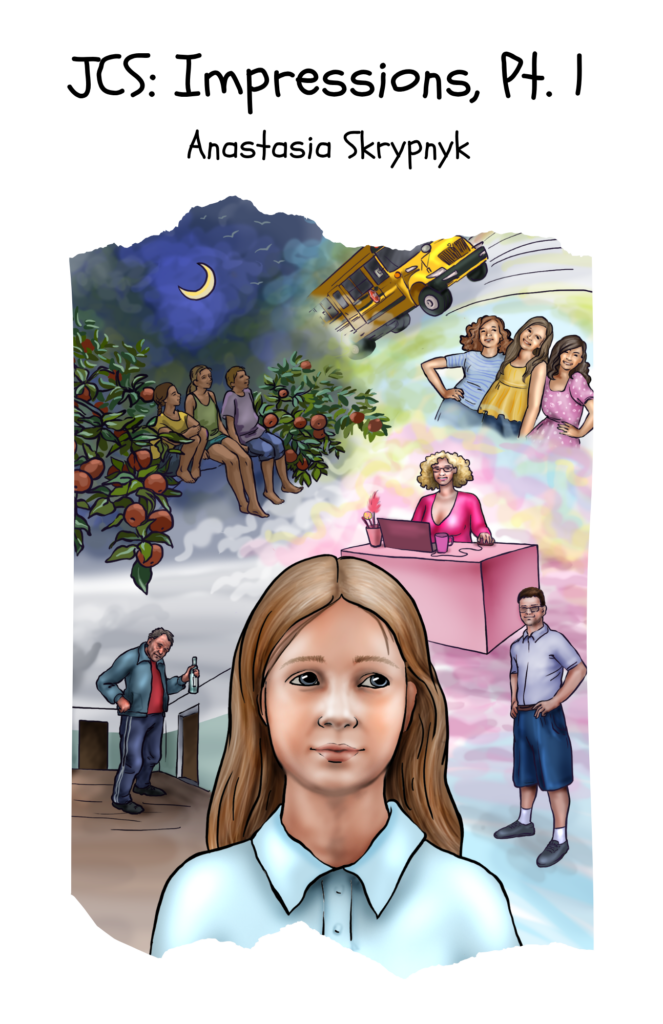
A Catholic elementary school, one of those flat single-floor ones with the big, wide, faded brown doors, one large Canadian and an even larger Ukrainian flag mounted at either side, stone-marbled floors that were so polished and squeaky clean you could practically lick them.
The attendance office was aglow with effusions of the fifty shades of pink: pink tulle, sparkly pink posters, sparkly pink pen cups with pink fluffy rims, pink office paraphernalia, pink cashmere sweater on the secretary with large breasts (I only point this out because she was wearing a dangerously low-cut V-neck sweater and I was a curious child) and a loud, exuberantly and overly polite Canadian “Hellooooo” that was about 5 syllables longer in real life than here on paper. Maternal. Almost the fairy-godmother of my American-movie-fueled imagination. I mumbled “Hello” in a quiet, practiced, heavily accented English under my breath. The school was empty save for a few staff and the principal, whom my parents and I came to meet.
He was a warm, tall, slender man with the perfectly coiffed, shiny, Patrick Swayze-Prince Charming hairdo that glowed and bounced as he approached us – jogging – in his navy gym shorts and grey activewear long-sleeve. Looking so all-American, so sporty. So different from the local town alcoholic headmaster back home, I thought, remembering the lobster-red skin, the bloodshot eyes, and the stench of alcohol mixed with last night’s sweat that he wore with a permanent aura of a hangover clinging to the crinkled polyester suit.
Did I mention “back home” was a tiny town in western Ukraine, currently with a whopping population of 6,135 humans and, at the time of these events, unlocatable on Google? No? I shall continue to refer to it as “back home” since that is what the town of Kitsman is to me.
Back in Toronto, in the lush greenery of West Deane Park in happy Etobicoke, was this shiny, glowing polar opposite, someone who could actually talk to kids, who exuded a sense of alertness and sobriety, and a sense of optimism that was almost overwhelming to me. Not a local drunk, that’s for sure. Everything was shiny, and I was in awe with every flick of his hair. My first impression of Canadian-Ukrainian school remains heavily and healthily defined by this athletic-looking man who looked like he’d never polished off a bottle of vodka before coming into work, the veil of Eastern European alcoholism lifting to make space for the Canadian Catholic School experience – clean, child-friendly, controlled substance-free, normal.
My imaginary Canada lacked development – my associations limited to shelves of Bratz dolls which I’d been collecting, Twizzlers and Winners where my mom bought me cute clothes, the famous Tim Hortons where I could get a jelly-filled flower-shaped doughnut to quench my sugary appetite and chubby girl dreams, (bring back the Strawberry Blossom, please), a soft moose toy in a woolen Toronto Maple Leafs sweater my father had sent over to Ukraine, and caramelized apples in the Laura Secord Chocolate store at Cloverdale Mall.
My 11-year-old mind couldn’t help comparing this to the starkly opposite – home – of what I’d known: the dilapidated brutalism of my small town Eastern European school with the hard concrete interiors, the broken central heating systems that would leave us cold in the wintertime of what used to be an internat* (boarding school for children of low income/less fortunate families – you’d think they would have heating in a place where people slept), the needles scattered in the sandpits of the school grounds, the student toilets which were just holes in the ground with no stalls or partitions of any kind (no TP either; no privacy), the hooch we were already sneaking into class in fifth grade. The stocky ladies clad in highlighter-yellow or highlighter-blue black-polka-dotted aprons in the sticky, hot grocery stores of my town didn’t wear beautiful pinks or greet you politely, but they also didn’t ID you. If you had money, you were king, and you could get anything your piggy bank could buy (bottom shelf) – no questions asked.
Even from a kid’s perspective, I remember back home as little else but broken dreams and broken bottles strewn about, signs of self-administered therapy. We were taught from a small age, albeit unintentionally, that drinking excessively, or drinking at school, or drinking at the park, or drinking underage, anywhere, was a rite of passage, a lesson in coolness – how to be an adult.
I sensed right away that this would be nothing like it, one sign being the LCBO, where my father, who looked every bit his 40 years of age, was asked to present his ID. He told me sternly and proudly that Canada was a place where alcohol control was serious, where no alcoholics would be caught sleeping off last night’s excess in the children’s parks (he hadn’t been to Kensington Market yet, I don’t think, and we were in family-friendly Etobicoke), and I was impressed to see the perfectly trimmed grass of the park across the street stretch all around without the sight of a drunk pissing by the fence, the dark corners of my childhood memory holding onto things I knew even then I never should’ve seen.
Those vestiges of small-town Ukraine, as captured by my child brain, continued to plague my perception of Canada – a sense of anticipation that some drunken ghost would come and appear on the park bench, but it never did, burrowed into my memory until I myself brought him to life, although much later on, having already learned how to forget.
Back home was a place far away, a place where toys were any object you could lay your hands on: rocks, leaves, rusty old nails, tiny ruby-coloured pebbles that turned out to be rat poison in the pidval** (basement coldroom where everyone kept their precious worthless junk), the neighbour’s kids’ grandpa’s old hidden soviet rubles (pretty, multi-coloured like fruit-loops, wrinkly and soft like rice paper, hidden contraband, now useless), sticks and stones and rotted apples, broken benches painted green and chipping slowly, remnants of a different time, frozen still in permanent degradation.
Don’t let this mislead you into thinking my childhood was dull. We had the collective imagination of dirt-poor kids who grew up without phones, computers and little to no parental supervision. The sweetest memories of my childhood are those sticky summer nights with the cicada’s jazz song all around us, my friends and I up in the apple tree, stargazing, fantasizing about tomorrow’s military battle, eating immature green apples with the juices flowing down our arms, quietly staining whatever old, ripped-up rag of a t-shirt I happened to be wearing. My mother would be screaming at the top of her lungs from our bedroom window for me to come inside, already running the shower because she knew my feet would be black as coal by the time I dragged my shlyopantsi*** inside.
We were the happiest of kids, bonded by a lurid imagination, ridiculously unruly, ever bespeckled with scabs and scars and scratches because we gave them no time to heal before the next imminent adventure would mark us up. I learned from the older boys how to wear my many scratches and bruises, like badges of honour, my battle scars. I never cried.
Until I did. Before long, there I was, at McCarthy’s, trying on a strange, ill-fitting and extremely expensive kilt skirt that limply hung down to my knees with an oversized safety pin on the front flap, and a myriad of identical polos with a fitted waistband and a crest on the front chest. Just like the fancy prep school kids from those Hollywood movies with a boarding school, I thought.
The price tags were scary, even though I lacked understanding when it came to the pricing of things, but my father’s shock and my mother’s anxiety about the purchase explained it away as beyond affordability. I was confused why something so (subjectively) ugly was so expensive, already seeing how backwards it was that the uniform, meant to be a great equalizer, was so beyond the budget of most newcomer families whose children would attend the school. I, already conscious of our financial situation when told there was no money for the dance classes I wanted to take or the Zellers trinkets I wanted to buy, was ready to abandon ship and leave the store, having no care for which school I would go to. But my father shut the argument down, bought me the whole $600 ensemble, including THE denim JanSport backpack of my dreams, and with a Blackberry in hand, I was ready for school bus pickup.
First day was a bumpy ride: the beautiful yellow school bus (just like in the movies!) that picked me up was a bleak affair inside, with hard and uncomfortable teal blue pleather seats, hard and uncomfortable stares from kids I didn’t know, and an uncomfortable semi-awareness that my budding breasts, magnified under a baby pink butterfly-printed bra (Walmart, George) were slightly visible through the crested polo shirt I’d been wearing. The awkwardness of the growing body (Exhibit 1: my mother congratulating me that I was a woman when I awoke in shrieks to find my green pajama pants covered in blood, assured that I had been murdered in my sleep, unaware of what a period was at the ripe age of 11) creeping itself into my bones, a heat-like sensation of guilt and shame spreading up into my throat, lanky and uncomfortable as I could not escape the feeling that I was naked and bleeding through my skirt as I climbed inside and propped myself in the front seat, shrinking so as not to be noticed, unaware of the unspoken rule that older kids always sat at the back of the school bus.
Eventually, the ride was over, and I disembarked and immediately noticed that absolutely no one was in full uniform. Pretty girls in navy shorts and Abercrombie & Fitch zip-ups, with the crested McCarthy polo peeking here and there, stood catching up in a language I hardly understood while my cheeks turned to a crisp tomato-red in that long, awkward kilt. I stood out like a sore thumb.
Somehow, I found my way inside, the anthem was played over the school sound system, foreign and meaningless to me, Our Father and Hail Mary were recited (I knew neither in either language but I did already know the first verse to Eminem’s We Made You). I was handed a quiz in French class by a teacher who wore a permanent expression of disgust on his face. My nervousness as I approached him and brokenly explained in my very ESL English that I had never taken any French (we learned English and German back home) was met with a cold and dismissive “Try your best.”
As I felt the awkward stares of kids all around, I went back to my desk and cried for the first time in public (back home, I was a grade-A student all my life, always landing at the top of every class). I quietly wrote my name on the tear-soaked page and put the pen down with defeated resolve, knowing that I knew nothing, embarrassed that I was falling apart in front of kids I’d hoped to impress. Defeat was the first lesson I learned in Canada, feeling stupid and lost just as I’d imagined my parents must have felt when they came here, hating it all and acutely agonizing over my beautiful, popular life back home.
At the midday assembly, we were gathered in the auditorium for prayer, all the kids plopping down on the ground into yoga positions, ready for the ritual.
I should mention we were not a particularly religious family, even back home, and I attended church solely for the purpose of running away to my babusia’s house next door, leaving mid-service on the pretense of feeling faint from the incense and raiding her cookie pantry. I still remember those thick zhushchenka-filled**** cookie rolls with one end dipped in coconut shavings as if within my arm’s reach once I stacked the right number of chairs to climb up to the pantry. I wasn’t sure if there was a god, but I was sure there was a pantry, and there was sugar, and that felt holy to me.
Being instructed to put my hands together in deep-felt prayer was a new experience and one that seemed almost funny to me, certainly out of place given the ages gathered were between 13-14, children barely conscious of themselves, let alone being conscious of God, or a holy deity of any kind. Let’s be honest, at most, we pre-teens worshipped One Direction or Justin Bieber or the Xbox – or all of the above. I felt disconnected from the Catholicism of Ukrainian schools here in Canada, my previous scholastic experience being completely devoid of any religious instruction, though filled with much day drinking and lessons in faking sobriety. Back home, by grade 6, you would have already had your first drink, if not a hangover, so I can’t hold God against my Canadian school too much – I was a child of hardcore post-communism, of Eastern European brutalism and of all the fun and trauma and pacifism that came along with it.
My Ukraine was not the Ukraine these kids knew about, not the Ukraine their grandparents told stories about or would have wanted to acknowledge. But it was mine, it was broken and beaten and drunk and deliciously mine, true, at times beautiful, often polluted and real. And I loved it then, and I love it still.
Back home, I’d been a popular kid. Heart-shaped little paper valentines flooded my desk in school on February 14th, girls brought their fake bazaar-bought Bratz dolls to me for authentication, and I obliged (mine were purchased with hard-earned birthday money or brought to me by my mother from Canada, making me the expert collector). I was always asked to dance at school formals, was always the life of the party, the entertainer, and had friends galore, but reality bites and my local stardom extended only as far as my hometown. My first friend in Canada was a weird skinny girl named Marisa, whom no one liked, who rode the bus with me until she eventually reported me for bullying because I stopped sitting next to her one day.
I still remember the sweat drops rolling down my back, the deep rage burning inside of me when I was pulled out of class into the principal’s office to learn what bullying was, and being forced to explain why I didn’t want to hold hands with her anymore while she sat sobbing next to me for no apparent reason. Unfortunately, Catholic school did not raise children to accept rejection and deal with it, but instead forced friendships in the name of Jesus.
I apologized, reassured Marisa that it was not my intention to hurt her feelings, and was on my way, confused that a principal would give a crap about my friendship with a random, overly emotional girl whom I did not physically harm or verbally abuse in any way. Back home, your feelings were your business, and unless a fight erupted, we were left to our own diplomacy to problem-solve relationships and pick our friends, thank you very much.
The irony here is that it wasn’t Marisa who was bullied, but me, and not by the Canadian-Ukrainian kids with expensive sneakers and iPhones and apres-ski attire whose opinion I feared and revered but the same FOB***** Ukie boys that were supposed to be like me and think like me and speak like me that tormented me and my newly-frizzy hair (it responded strangely to the chemicals here and poofed up for no reason at all, much to my detriment) by calling me chewbacca. The joke was lost to me because I’d never seen Star Wars, but unlike Marisa, I never reported anyone because I was no snitch, and I endured my pain in silence.
In truth, which I must tell even though the big G-o-d is watching, I stopped sitting next to Marisa because she was a little annoying and wanted to eat lunch with the teachers like a teacher’s pet and rat on the kids who ran in the halls (it turns out she clung onto me like a piece of gum because no one wanted to be friends with her and I was fresh meat and unaware of the no-Marisa social code).
On the upside, with my newfound notoriety that came with ditching Marisa and being pulled out of class like a tough kid (street cred still applied and was valuable currency in Catholic school, thank God) came solidarity from the girls who’d rejected her before I’d even arrived, and pretty soon, I was in with that crew.
The psychology of child cliques needs to be studied, but something changed after that office visit, and suddenly everyone was curious to know more about me. Besides the weird exclusion of Marisa (which eventually ended, and she did find good friends and is probably doing just fine, don’t worry), the Canadian kids were generally far kinder to me, and mostly left me to mind my business. Boys clung to me like an exotic specimen with questions and games and truth and dares and attention I wasn’t getting back home, girls taught me where to shop (Aritzia, A&F, Hollister were the holy trinity) and not to shop (Walmart) and what brands to be on the lookout for (I am sorry, mother, for demanding TNA yoga pants, and Abercrombie sweats, and the real Uggs, which you could not afford), which bands to listen to (One Direction, of course) and what shows to watch (Gossip Girl, Pretty Little Liars – thank you XOXO), and pretty soon I was equipped with a clear curriculum for the re-education and re-integration of my little innocuous mind.
Eventually, I made some real friends – girls I’d spend the next 7 years bonding and falling apart with, dancing and ditching class with and faking school bus slips to go to each other’s houses, and wasting away at Sherway Gardens.
However, had it not been for the cruel abandonment of a certain teacher’s pet whose hurt, angry little face I still remember like a bad stomach ache, I may have never been approached by a beautiful, Barbie-like, dirty blonde-haired girl who came to rescue me from Marisa’s grip. Her name was Yuliya, and she would become my first true friend. Clad in Abercrombie & Fitch, she approached me in the schoolyard, warmly inquiring what I was listening to, telling Marisa to piss off. She, like me, came from Ukraine, and like me, hated Marisa, and the stupid, ugly Ukie boys who called us names while eating their own boogers for lunch, and like me, wanted to cut out everything we had in common with them, and so began our friendship.
Everything is easier with a friend, and I no longer had to suffer in silence (or in Marisa’s forced company). My new BFF and I quickly switched to English, in the name of practice, until it fully eclipsed our use of the Ukrainian language and we could comfortably disappear into sterile, new Canadian identities, a sterile, new language (in which no one threw insults at us), and a sterile new friend group free of the baggage and trauma and whispers of being those Ukie girls, those FOBs, those weirdos.
An inevitable rite of passage that remains absolutely necessary for the social success of every immigrant child, while more often than not ripping apart their family, is assimilation. Mine was 100% voluntary, wholeheartedly desired, and exponentially accelerated by a deep, festering sense of shame and hatred for my otherness, for the part that understood my bullies’ taunting of me, for not being from here, for being from that elsewhere that I shared with those I most hated at this new school. I would be lying if I said I was proud to be Ukrainian then because I wasn’t.
My re-education was fast with the help of a great ESL teacher and the Nancy Drew series she’d lent me, so while the Ukie boys sat around basking with pride in their resistance to learn English as quickly as possible and excel in class, I dedicated all my time and effort to doing just that: through Oxford dictionaries and English movies and any English media, I welcomed my becoming with excitement and anticipation.
I aced ESL class in just one year, much faster than all the other kids, making a full switch in no time. Fueled by rage against my adversaries and an obsessive need to fit in, I gave up a huge part of myself, though only to regret it years later when I began to realize how much language I’d forgotten, how much grammar and fluency and pride slipped through my fingers, leaving me paralyzed in my mother tongue.
For me, the Canadian-Ukrainian experience will forever be marked by a sense of displacement, that sudden and complete ripping away of my culture, a poignant loss of a past in favour of blending into the safety of the mainstream. No kid wants to stand out for being different, for being foreign and other. Prefacing my Canadian-Ukrainian identity lies a profound sense of loss: of the language, the culture, the innocence of a childhood long gone. In gaining a new language and a new identity, I lost much of my younger self, and while the trauma lingers and the bombs rain and thunder back home, I hold onto these moments, picking apart the past, bitterly, as it slips through my trembling fingers.
*internat: typically, a boarding school where students live during term time; in this case, lower income
**pidval: basement coldroom, used for storage
***shlyopantsi: slippers
****zhushchenka: condensed milk
*****FOB: “fresh off the boat,” a phrase used to describe an immigrant, often offensively as it was used in my school to refer to Ukrainian kids/newcomers